

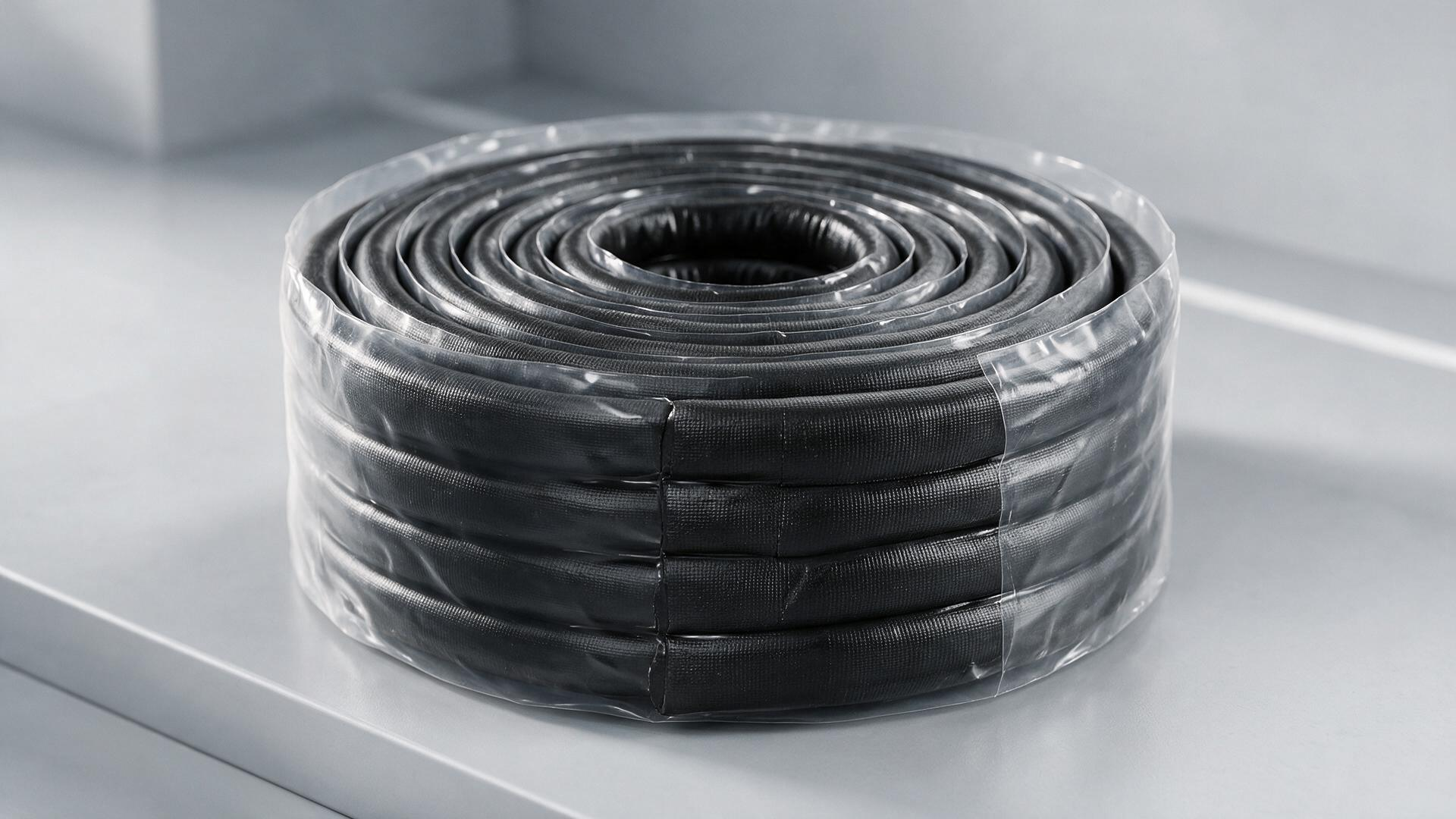
Production Process & Kneading Stage
Butyl rubber (IIR) is highly damping, elastic and poorly conductive. Typical line: mastication → filler/plasticizer incorporation → vulcanization system compounding → sheeting/forming. The intensive kneader (internal-mixer type) owns mastication and filler dispersion, which directly determine air tightness and damping performance.
Typical kneading sequence:
- Mastication: raw rubber blocks intensively sheared to reduce Mooney viscosity and build plasticity; friction heat is severe, so jacket cooling runs in parallel;
- Filler incorporation: carbon black/silica added in portions, each fully wetted ("wet-out") before the next;
- Plasticizer & additives: plasticizer added in steps to avoid slipping; curatives added last at low temperature to prevent scorch;
- Vacuum deaeration: removes air entrained during mastication, reducing bubbles and dimensional defects;
- Discharge: hydraulic tilting discharge to the next milling/calendering step.
Key controls: heat management (overheat means degradation or pre-cure), filler dispersion uniformity, traceable temperature/time batch records.
Material Characteristics → Equipment Requirements
| Material characteristic | Process impact | Equipment requirement |
|---|---|---|
| Rubber blocks, high Mooney viscosity | Extreme shear load | High-torque gearbox, heavy-duty bearings, reinforced body |
| Poor conductivity, intense friction heat | Local overheat / pre-cure | Forced jacket cooling (chilled water), interlocked temperature alarm |
| High elasticity, severe air entrainment | Bubbles, dimensional instability | Vacuum degassing system |
| Sticky, hard to discharge | Residue, cross-batch contamination | Hydraulic tilting or screw discharge |
| High air-tightness demand | Poor dispersion = leakage | High-shear blade set, dispersion sampling checks |
Select a butyl kneader by torque margin and cooling capacity — a shortfall in either shows up as uneven dispersion or scorch.